


The United Nations Standing Police Capacity (SPC) is the rapidly deployable operational asset of the Police Division based at the UN Global Service Centre (UNGSC) in Brindisi, Italy. The SPC provides police and law enforcement start-up and surge capabilities for peacekeeping operations and special political missions. The SPC advises and provides expertise on police and law enforcement, including preventing violent conflict and sustaining peace, by assisting United Nations missions in the maintenance of law and order, protection of civilians and police capacity-building. The SPC can also conduct operational assessments, evaluations and quality assurance of police components, including assisting in mission transitions, drawdowns and closures, as well as supporting other UN entities as directed by the United Nations Police Adviser.
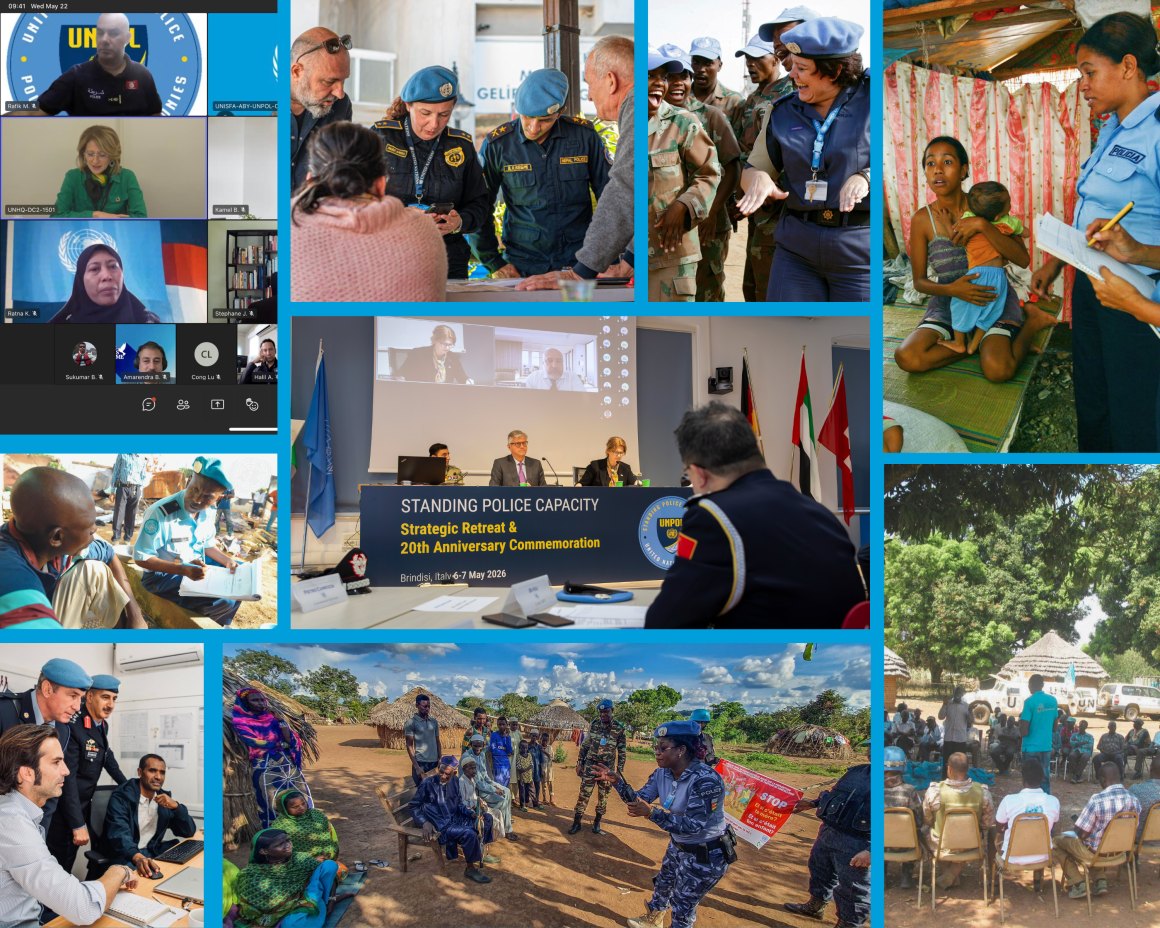
The SPC consists of 29 officers with specialist knowledge and experience across multiple disciplines, including leadership management, police reform and restructuring, public order, transnational organized crime, community-oriented policing, legal affairs, analysis, training, planning, logistics, budget and funds management, human resources, information and communication technology, environmental policing, investigations and gender advisory services.
From 2024 to 2026, SPC undertook the below projects in line with its core functions:
In MONUSCO (Democratic Republic of the Congo), the SPC offered support on Civilian Harm Mitigation (CHM); development of Police Comprehensive Disengagement Plan and Annual Work Plan; and development of Police Contingency Plans.
In MINUSCA (Central African Republic): offered support on the development of Road Plan for Police and Comprehensive Planning and Assessment System (CPAS); revisions of police Concept of Operations (CONOPS) and Protection Support Unit (PSU) Standard Operating Procedures (SOP); a criminal database project; the implementation of the National Capacity Building Plan; and development of comprehensive crime intelligence training curricula.
In UNFICYP (Cyprus): supported the Military and Police Capability Study (MPCS); the establishment of UNPOL Planning, Reporting, Analysis and Knowledge Management System (PKAKSYS); and interim leadership as Acting Senior Police Adviser.
In UNISFA (Abyei): supported the implementation of the Rule of Law Support Strategy for Abyei, and the mission-specific Standard Operating Procedures (SOP) for detentions by UNISFA; the delivery of a community-oriented policing (COP) and Women, Peace and Security (WPS) agenda integration training; and strategic assessment.
In UNMISS (South Sudan): the SPC supported on election security; the establishment of UNPOL Planning, Reporting, Analysis and Knowledge Management System (PKAKSYS); the project management and donor coordination capacity building programs; and on interim leadership as Capacity Building and Development Adviser.
BINUH (Haiti): supported the revision of Mission Concept, police and correction Concept of Operations (CONOPS); the roadmap for the development of a new Strategic Development Plan for Haitian National Police (HNP); and the delivery of a strategic planning training to HNP.
In UNOWAS (West Africa and the Sahel), supported in identifying key peace and security challenges and strengthening the strategic role of policing within the mission.
In UNSOM/UNTMIS (Somalia): supported on interim leadership as Head of the Police Component; on joint baseline assessment of community policing practices, training, and community engagement; and on preparation of Police handover note.
In UNMIK (Kosovo): supported the delivery of gender-focused training.
In UNSMIL (Libya): supported the revision of the Concept of Operations (CONOPS).
The SPC may also be requested to provide expertise to other UN partners, such as the Department of Political and Peacebuilding Affairs (DPPA) as well as UN Agencies, Funds, and Programmes through, in particular, the Global Focal Point for Police, Justice and Corrections (GFP). SPC also receives requests for assistance from intergovernmental and regional organizations, in addition to Member States that do not host a UN peace operation. Furthermore, SPC may provide training support to Member States or regional organizations and conduct specialized training courses for UN Police officers serving in the field. Interventions from 2024 to 2026 included:
UNDP Iraq: supported the delivery of a “Training of Trainers” (ToT) program to strengthen the capacity of Iraq’s police.
UNOCT Morocco: the delivery of a “Training of Trainers” (ToT) course under the UNOCT Global Fusion Cells Program.
UNODC Guinea: supported the delivery of regional police training and simulation exercises on lawful crowd control; drafting of “Handbook for Law Enforcement on Facilitating the Right to Peaceful Assembly, Including Peaceful Protests”; and the development and validation of a manual on peaceful demonstration management and policing.
IOM Moldova: Support on delivery a Community Policing Training Program.
SPC also works closely with, inter alia, the Policy, Evaluation and Training Division (DPET) to transmit experiences from the field and identify, implement and promote effective UN policing practices. It supports and provides expertise in training initiatives and encourages the use of knowledge management (KM) tools to further the mission of the UN Police. Since 2019, SPC has been engaged in the UNPOL Training Architecture to develop new UN Police training materials and ensure compliance with the Strategic Guidance Framework for International Policing (SGF), and has provided support to DPET in developing and rolling out the Comprehensive Planning and Performance Assessment System (CPAS) in five peace operations.
In carrying out its tasks, SPC supports the implementation of today’s often complex policing-related tasks in the broader rule of law and security sector reform context: integrating human rights into law enforcement; enhancing the protection of civilians; preventing and responding to sexual and gender-based violence; promoting the role of women in peace and security; and building effective, efficient, representative and responsive police institutions.